- Nov 13, 2025
The ChatGPT Tells Killing Your Credibility
- Vicky Snyder
- 0 comments
You're using AI to write, and that's completely fine.
We're all using it. I help people use it for a living. AI writing tools are part of the professional toolkit now, just like spell-check and Google Docs.
But what you may have yet to realize are the series of phrases and patterns that have become synonymous with "ChatGPT wrote that". And when they show up in your writing - the formulaic phrases, the predictable structures, the robotic transitions - you're telling your reader that you didn't care enough to add your own voice.
If you had spinach in your teeth, you'd want someone to tell you, right? This is me telling you.
Your audience might not consciously think "this was written by AI," but something feels off. The writing feels generic. Like they've read that same sentence before. A little too polished in a formulaic way. And in a world where everyone has access to the same tools, these telltale "ChatGPT wrote that" signs make even great ideas fall flat.
The Patterns Everyone's Learning to Recognize
Here are the phrases that have become ChatGPT's signature moves. You may be editing some of them out already (goodbye em dashes) but there are certainly a few you haven't yet realized. When they show up in your writing, you might as well watermark it with the ChatGPT logo.
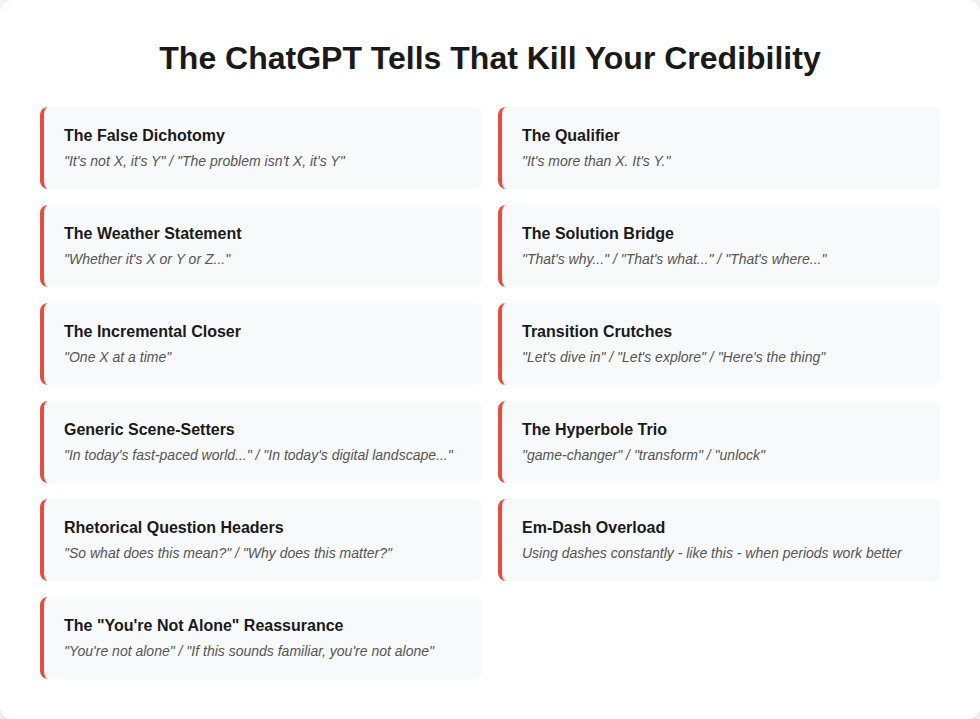
1) The False Dichotomy Formula
The pattern: "It's not X, it's Y." / "The problem isn't X, it's Y." / "Not because of X, but because of Y." / "This isn't about X. It's about Y."
Why it stands out: This is ChatGPT's favourite way to create contrast and drama. It shows up constantly.
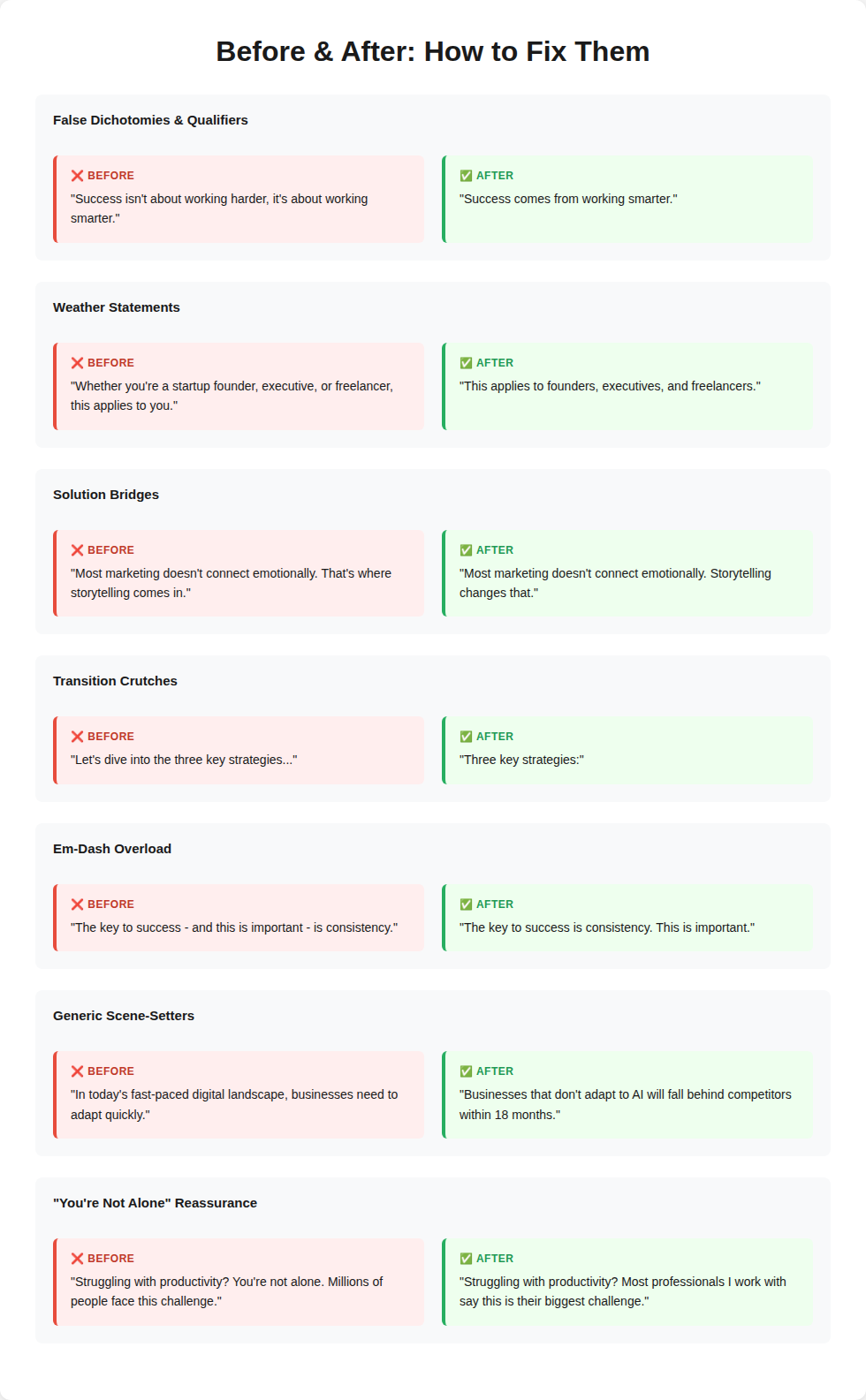
Example: "Success isn't about working harder, it's about working smarter."
How to fix it: Just say what it IS. Cut the "not X" part entirely.
-
After: "Success comes from working smarter."
Or: "Working smarter leads to success."
2) The Qualifier
The pattern: "It's more than X. It's Y."
Why it stands out: It's an unnecessarily wordy buildup that ChatGPT uses constantly.
Example: "Leadership is more than just managing people. It's about inspiring them."
How to fix it: Skip straight to what it actually is.
After: "Leadership is about inspiring people."
3) The 'Whether' Statement
The pattern: "Whether it's X or Y or Z..."
Why it stands out: This is ChatGPT's way of trying to sound comprehensive.
Example: "Whether you're a startup founder, a corporate executive, or a freelancer, this applies to you."
How to fix it: Ask ChatGPT to rephrase without "whether," or do it yourself.
-
After: "This applies to startup founders, corporate executives, and freelancers."
Or: "This applies to you."
4) The Solution Bridge
The pattern: Starting a sentence with "That's why..." / "That's what..." / "That's where..."
Why it stands out: It's a mechanical way to transition from problem to solution.
Example: "Most marketing falls flat because it doesn't connect emotionally. That's where storytelling comes in."
How to fix it: Connect more naturally using the actual context.
-
After: "Most marketing falls flat because it doesn't connect emotionally. Storytelling changes that."
Or: "Storytelling creates the emotional connection most marketing lacks."
5) The Incremental Closer
The pattern: "One X at a time."
Why it stands out: ChatGPT loves this for conclusions because it sounds motivational. It's become overused.
Example: "Building your business, one customer at a time."
How to fix it: Be specific about what you actually mean.
-
After: "Focus on serving each customer exceptionally well."
Or: "Growth happens through word-of-mouth from happy customers."
6) The Transition Crutches
The pattern: "Let's dive in." / "Let's explore." / "Here's the thing:"
Why it stands out: These feel artificial, They're addressing the reader in a way that actual writing rarely does.
How to fix it: Just start. Your reader is already here.
Before: "Let's dive into the three key strategies..."
After: "Three key strategies:" or just start with "The first strategy is..."
7) The Generic Scene-Setter
The pattern: "In today's fast-paced world..." / "In today's digital landscape..."
Why it stands out: It's filler when there's nothing specific to say.
How to fix it: Cut it entirely, or replace with something specific.
Before: "In today's fast-paced digital landscape, businesses need to adapt quickly."
After: "Businesses that don't adapt to AI will fall behind competitors within 18 months."
8) The Hyperbole Trio
The pattern: Overusing "game-changer," "transform," "unlock"
Why it stands out: ChatGPT defaults to these words when trying to make something sound important. They've lost meaning.
How to fix it: Be specific about the actual impact or benefit.
Before: "This tool will transform your workflow."
After: "This tool cuts report-writing time from 2 hours to 20 minutes."
9) The Rhetorical Question Headers
The pattern: Using questions as section headers: "So what does this mean for you?" / "Why does this matter?"
Why it stands out: It's a mechanical way to create engagement.
How to fix it: State the point directly. Questions work better in body text.
Before: "So what does this mean for you?"
After: "What this means for you:" or "The practical impact:"
10) Em-Dash Overload
The pattern: Using em-dashes as a crutch - often to add clarifying information - when simpler punctuation would work better.
Why it stands out: ChatGPT loves em-dashes for conversational flow, but overusing them makes writing feel breathless.
How to fix it: Use periods. Embrace shorter sentences.
Before: "The key to success - and this is important - is consistency."
After: "The key to success is consistency. This is important."
11) The "You're Not Alone" Reassurance
The pattern: Stating a rhetorical question and then following it with, "You're not alone." / "If this sounds familiar, you're not alone."
Why it stands out: This is ChatGPT's go-to empathy move. It's trying to make the reader feel validated, but it's become such a cliche that it has the opposite effect. It feels robotic rather than genuinely understanding.
How to fix it: Show understanding through specificity rather than generic reassurance.
Before: "Struggling with productivity? You're not alone.."
-
After: "Struggling with productivity? Most professionals I work with say this is their biggest challenge."
Or: "This productivity struggle is common. I see it with nearly every client in their first month."
Or: Just skip the reassurance entirely and go straight to the solution: "Struggling with productivity? Here's what works..."
The fix is either being specific about who else experiences this (which feels more real) or just acknowledging the problem and moving to help, rather than offering hollow comfort.
Moving Forward
If you're reading this and recognizing some of these patterns in your own writing, now you know.
Using AI is smart. But using AI, and then taking ten minutes to remove these patterns is becoming essential if you want your writing to stand out.
Your writing represents you. It's often the first impression potential clients, partners, or employers get. When these telltale phrases show up, you're accidentally signaling two things: First, that you didn't take the time to make it yours. And second - and this one may sting - that you don't think your reader is smart enough to notice.
When I see ChatGPT-isms in someone's writing, I feel personally insulted, like they assumed I wouldn't catch them. Like they thought I'd read "you're not alone" or "cut through the noise" for the hundredth time and not be bothered by it.
And beyond that, it's exhausting. We're all drowning in the same generic syntax, the same cadence, the same phrases across all communication channels. When your writing sounds exactly like everyone else's AI-generated content, you're adding to the noise instead of breaking through it. (a classic ChatGPT-ism!!!)
So keep using ChatGPT, Claude, or whichever AI writing tool makes your work easier. Just add one more step: Scan for these phrases and edit them out. Make the writing sound like you.
Remember that the people reading your work are using AI too. They recognize these patterns. And whether they consciously realize it or not, they're forming impressions about you based on whether your writing feels personal or feels like ChatGPT.
You put thought into your ideas. Make sure your writing reflects that.
Ok, so now tell me..... Where are the ChatGPT-isms in MY writing?? I used Claude to help me put this piece together, and the first draft had about ten of the same AI-isms I'm calling out in this post.